Jack Gartenberg (1926 – Oct 26, 2019)
Jack Gartenberg, 93, of Parsippany died October 26, 2019. Born in Brooklyn and raised in the Bronx, he lived in Parsippany for 40 years before his death.
Mr. Gartenberg graduated from City College of New York with a degree in mechanical engineering. He worked designing piping systems for nuclear power plants until his retirement.
Jack served his country as a member of the 4th Division of the U.S. Marine Corps during World War II, where he was wounded in the Battle of Iwo Jima and earned a Purple Heart.
During his retirement, he enjoyed being an avid stock and bond trader. He was an enthusiastic reader and collector of books about World War II and became a sought-after speaker at veterans’ groups, organizations, and schools. Over the years, local newspapers interviewed him for feature articles about his wartime experience.
He took on leadership roles in several veterans’ organizations, serving as commander of Morris County Chapter 246 of the Military Order of the Purple Heart for the past 15 years; earlier, he was president of the 4th Marine Division Association, Garden State chapter, member of the Jewish War Veterans in Livingston, and American Legion Post 43 in Florham Park.
He was also a life member of the Marine Corps League Slattery Detachment in Whippany.
Predeceased by his wife, Bernice, in 2005, he is survived by his daughter, Barbara; his son, Michael (Lisa); and two grandsons.
In February 2016, Jack shared war memories with marines at Picatinny Arsenal. The following was reported by Eric Kowal:
In November 1944, just before he left for the war, Gartenberg was assigned with the 4th Marine Division and went to Maui, Hawaii for training. His first assignment was guarding Japanese prisoners who were being transferred to the U.S.S. Indianapolis for interrogation.
“The problem with the Pacific War was that most people didn’t know where it was,” Gartenberg told the Marines.
“There was the Battle of Guadalcanal. Ok, well, where was Guadalcanal?”
“On the Solomon Islands. Ok, where were the Solomon Islands?”
Again the Marines laughed, but quickly fell silent to continue listening to the man who lived through the battle that every Marine is familiar with through tradition and knowledge handed down by generations of Marines before them.
“We boarded ship, January 1, 1945, and we had no idea where we were going,” Gartenberg said. “You couldn’t even see Iwo Jima on a map. Not that anybody knew about it either,” he added. Gartenberg said that because of the erroneous intelligence they received, they were completely unprepared for what they were about to endure.
“We were told there were 10,000 Japanese troops and the fight would take eight to ten days,” he said. “There ended up being 22,000 troops and the eight to ten days turned into five weeks.” Gartenberg said that although they fired upon the island from their ships, the Japanese did not return fire. “They didn’t want to reveal their positions,” he explained.
“The beaches were covered with black volcanic ash. We would later find that our tanks would get bogged down and our weapons would not fire because they would get clogged.”
“You couldn’t dig a foxhole for protection because the ash just didn’t allow it,” he said. “Initially I was a rifleman, but then assigned to a machine gun. “They took my M1 away and gave me a machine that didn’t have a sling. I had to use my bed roll as a sling,” he added.
Gartenberg described the scene once the fighting really took hold. “Every square foot of beach was covered by mortar and artillery fire,” he said. “Marines don’t retreat!” Gartenberg blurted out with intensity. “We took that fire for three days and nights before capturing the airfield.”
Gartenberg’s tone then changed as he shifted from describing the battle to how news of the battle was received back in the states. “There was a ton of criticism back home. The papers described the loss of four or five thousands Marines on an island that nobody ever heard of before,” he said. “People questioned why we were there. People questioned our generals, and the Marines fighting the war.
“Then when that iconic photo of the flag raising on Mt. Surabachi hit home, then everything changed. Now the tide had turned. That photo changed the entire concept of the battle.” Gartenberg was referring to the famous Associated Press photo taken by Joe Rosenthal. The photo captured a second flag raising after the mountain had been captured.
Gartenberg recalled what it was like to actually witness the original flag raising on February 23, 1945. “When the first flag went up there was so much cheering you would have thought it was Times Square on New Year’s Eve.”
Again, quite abruptly, Gartenberg’s demeanor changed. What was a glorious moment and incredible memory quickly turned to sadness. “6,821 Marines were killed in action and another 20,000 wounded,” he said somberly. “One third of all Marines killed in the Pacific were killed at Iwo Jima.”
Gartenberg, he not only lost friends during that battle but feels that the battle and its high loss of life might have been forgotten were it not been for Rosenthal’s photo. “I asked other fellas years later, ‘Do you think people would be talking about Iwo Jima if the photo had not been taken?’ Sadly, they said, ‘No.'” he said.
After Gartenberg spoke, the Marines had a chance to ask him a few questions. Several Marines want to know about living conditions, weaponry and gear. One Marine asked Gartenberg if he recalled what the atmosphere or spirit of the men was like as they approached the island on ship. “Most of the men were more concerned about Kamikaze’s hitting the ship then they were about what was about to happen,” he said.
“If you remember, the intel we received couldn’t have been further from the truth. Some of these guys were going into their third and fourth battles so it was becoming routine. Some thought maybe their time was up and they would finally end up dead or wounded, but I remember it being like a calm before the storm.”
In November 1944, just before he left for the war, Gartenberg was assigned with the 4th Marine Division and went to Maui, Hawaii for training. His first assignment was guarding Japanese prisoners who were being transferred to the U.S.S. Indianapolis for interrogation.
“The problem with the Pacific War was that most people didn’t know where it was,” Gartenberg told the Marines.
“There was the Battle of Guadalcanal. Ok, well, where was Guadalcanal?”
“On the Solomon Islands. Ok, where were the Solomon Islands?”
Again the Marines laughed, but quickly fell silent to continue listening to the man who lived through the battle that every Marine is familiar with through tradition and knowledge handed down by generations of Marines before them.
“We boarded ship, January 1, 1945, and we had no idea where we were going,” Gartenberg said. “You couldn’t even see Iwo Jima on a map. Not that anybody knew about it either,” he added. Gartenberg said that because of the erroneous intelligence they received, they were completely unprepared for what they were about to endure.
“We were told there were 10,000 Japanese troops and the fight would take eight to ten days,” he said. “There ended up being 22,000 troops and the eight to ten days turned into five weeks.” Gartenberg said that although they fired upon the island from their ships, the Japanese did not return fire. “They didn’t want to reveal their positions,” he explained.
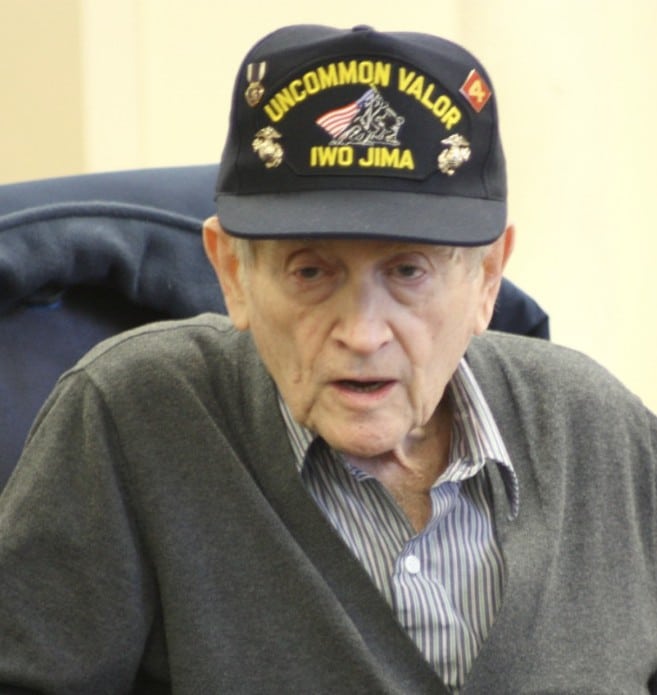
Jack Gartenberg died on October 26, 2019.
“The beaches were covered with black volcanic ash. We would later find that our tanks would get bogged down and our weapons would not fire because they would get clogged.”
“You couldn’t dig a foxhole for protection because the ash just didn’t allow it,” he said. “Initially I was a rifleman, but then assigned to a machine gun. “They took my M1 away and gave me a machine that didn’t have a sling. I had to use my bed roll as a sling,” he added.
Gartenberg described the scene once the fighting really took hold. “Every square foot of beach was covered by mortar and artillery fire,” he said. “Marines don’t retreat!” Gartenberg blurted out with intensity. “We took that fire for three days and nights before capturing the airfield.”
Gartenberg’s tone then changed as he shifted from describing the battle to how news of the battle was received back in the states. “There was a ton of criticism back home. The papers described the loss of four or five thousands Marines on an island that nobody ever heard of before,” he said. “People questioned why we were there. People questioned our generals, and the Marines fighting the war.
“Then when that iconic photo of the flag raising on Mt. Surabachi hit home, then everything changed. Now the tide had turned. That photo changed the entire concept of the battle.” Gartenberg was referring to the famous Associated Press photo taken by Joe Rosenthal. The photo captured a second flag raising after the mountain had been captured.
Gartenberg recalled what it was like to actually witness the original flag raising on February 23, 1945. “When the first flag went up there was so much cheering you would have thought it was Times Square on New Year’s Eve.”
Again, quite abruptly, Gartenberg’s demeanor changed. What was a glorious moment and incredible memory quickly turned to sadness. “6,821 Marines were killed in action and another 20,000 wounded,” he said somberly. “One third of all Marines killed in the Pacific were killed at Iwo Jima.”
Gartenberg, he not only lost friends during that battle but feels that the battle and its high loss of life might have been forgotten were it not been for Rosenthal’s photo. “I asked other fellas years later, ‘Do you think people would be talking about Iwo Jima if the photo had not been taken?’ Sadly, they said, ‘No.'” he said.
After Gartenberg spoke, the Marines had a chance to ask him a few questions. Several Marines want to know about living conditions, weaponry and gear. One Marine asked Gartenberg if he recalled what the atmosphere or spirit of the men was like as they approached the island on ship. “Most of the men were more concerned about Kamikaze’s hitting the ship then they were about what was about to happen,” he said.
“If you remember, the intel we received couldn’t have been further from the truth. Some of these guys were going into their third and fourth battles so it was becoming routine. Some thought maybe their time was up and they would finally end up dead or wounded, but I remember it being like a calm before the storm.”
Gartenberg was wounded in a fight for Charlie Dog Ridge on his ninth day on Iwo Jima. The entire battled lasted from February 19 — March 26, 1945.